

050 · What Creativity Really Is
You've got it, no matter what...
Somehow, in times past, the idea of creativity took on a definition that separated us from it, as if we could possibly exist without having it, and as if some people have it and some people don’t.
That outdated notion keeps us locked inside a mistaken creative identity, thinking we have to rely on luck or special tools to make the art we yearn to make, or to fully live the life we most want to live.
Instead of defining creativity as an ability to imagine or make something unique, what if creativity is trust in our own alternate reality?
Using this updated, more inclusive and accessible definition, we access our ability to be creative by leaning into the special and unique world each of us naturally, unavoidably, and constantly occupies as ourselves. I know this is a simple idea, but I’m amazed at how often I lose touch with the source within, and how much people I know also struggle with locating a path to being more authentic about their creativity.
Just yesterday, I spoke with a professional artist friend who’s had a long and fruitful career, including awards and public recognitions, and yet he confessed that he still struggles at times to connect with the part of him that knows how to relax into trusting that original ideas will come. He talked about the difficulty of engaging in self-enquiry around artistic practice, especially around playful exploration. When he came across probing questions online that invited him to examine his inner landscape around this issue, he immediately turned away in avoidance, uncomfortable with where his answers might take him.
I know that particular artist well enough to know something about his history and the push-pull tension he experiences between always wanting what he makes to be excellent in other people’s opinions, but also wanting to make something unique. Trying to figure out what might sell sometimes gets in the way of determining whether or not the thing created is a genuine expression.
I consider all such wrestling matches characteristic of a life affected by false overlays of history, as I call them—those experiences, large and small, of when our genuine creative impulses were stomped on or dismissed. Little hurts of dismissal add up, especially if they started when we were too young to decide for ourselves what we thought of our own creative efforts and to stick up for ourselves in the face of dissent. The big hurts may have convinced us we can’t be creative at all—and, oftentimes, we can’t when we’re struggling under those overlays. That makes it harder to find the secret, hidden core of us that believes we are creative.
The crucial piece is that since our unadulterated inner authentic self is the source of our creativity, then we can’t be separated from our creativity, not ever.
What does it look like to operate under the definition of creativity that is trust in our own alternate reality? Here are some examples:
Making something even when the overlays call it “ugly”
Toying with your answers to these questions: What is my alternate reality? and What do I really think about this? and What do I actually want?
Admitting to yourself what you most love, what you truly love, and taking action to support yourself around it
Deciding to move and then moving in a direction that feels true to you, even though someone else disapproves
Letting go of something you realize you don’t resonate with, in favor of something better for you
Giving your alternate reality inside you a chance to exist in the material world by making or doing something, anything, even if you can’t yet see how the end result will turn out
Gathering some physical items that represent your secret core desire, as reminders that you know what you love and what you want, even in the times when you can’t consciously access that internal place
Defending the space and time you need for exploring creating from your own alternate reality, even if it’s only a few minutes now and then
Spending quality time with yourself by being fully present as you make something
The way we can consciously touch that inner realm is by practicing, like by trying the suggestions above or others you discover and stumble upon for yourself. We thus build self-trust. We practice figuring out how to trust our own selves.
Believe me, I am practicing this too. I’m often scared as I practice this. I sometimes cry. But what I find interesting and promising is that when I cry during a creative practice, the reason mostly has to do with the moment an overlay lifts off and dissolves. The emotion is one of sudden relief followed by a sense of greater freedom and greater self-trust.
I get to those moments by trying something, by practicing, despite the voice that tries to stop me, and by moving my body in the material world to attempt to make something that originates from the place that’s true inside me. This can bring the overlays into conscious view, making them ripe for dismantling. The more free of overlays we become, the easier it is to access and trust our own alternate reality as we make things—including making a life.
If it feels like it may help you, you can use my trust in you as a back-up boost while you practice giving your yearnings space to exist in the world outside of you as your creativity.
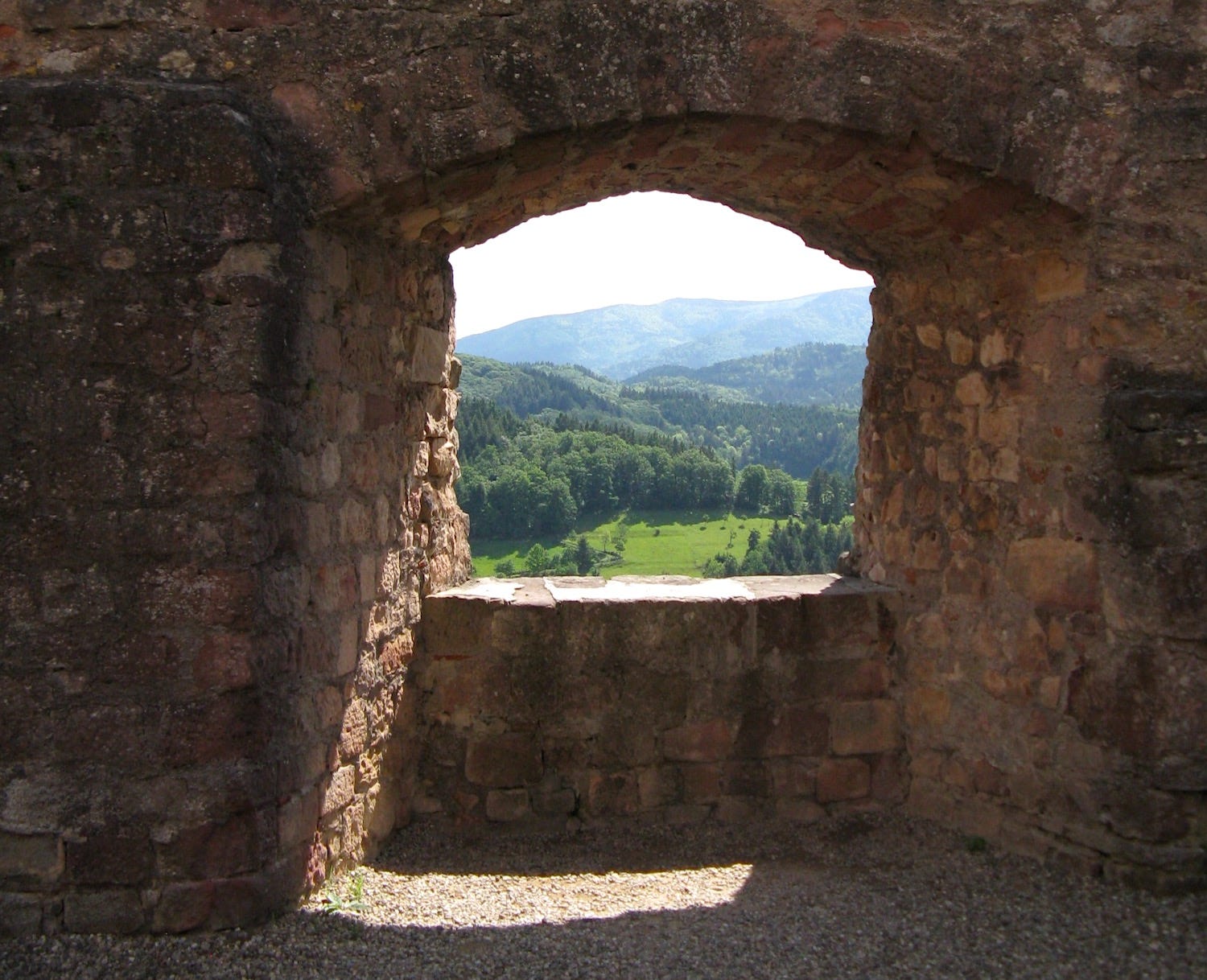
About the Photo | Portal View
Hochburg Castle, Emmendingen, Germany, 2012
On a bright, beautiful day in May, a friend and I took a day trip from where we lived in Freiburg, Germany, to the ruin of Hochburg Castle, near the town of Emmendingen. I romped gleefully hither and yon with my camera, captivated by the nooks and crannies, the heavy stone, and the unknown stories within the former rooms turned into open-air courtyards surrounded by crumbled walls.
This particular photo moment gave me feelings of recognition. I know the closed-in sensation that yearns for a clearer view, for an escape hatch through which to soar into a sunlit space welcoming to my spirit. But I also acknowledge an affinity for closed-in safety, for shelter from the storms of life. Somehow, the contrast between the two settles me more than having to choose one or the other.
In the same way, I consider the effort that is at times required to access the flights of authentic creativity to be worthy of our experience. Contrast helps us identify the openings.
Thank you for sharing! I always need a reminder that it's ok to create the "ugly" bits, even if it's just for myself.